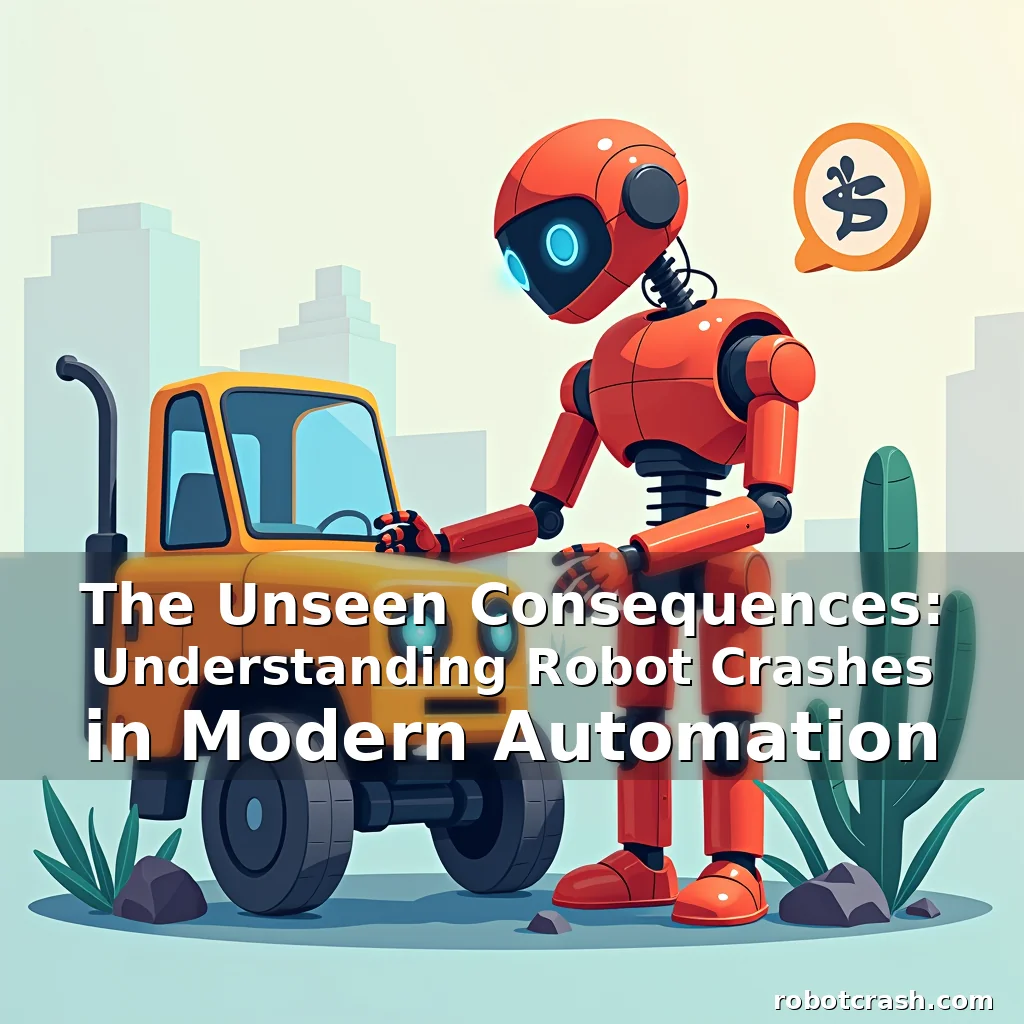
The Unseen Consequences: Understanding Robot Crashes in Modern Automation
In an era defined by rapid technological advancements, robots have become integral to various sectors—from manufacturing lines to autonomous vehicles—yet their occasional failures remain a critical concern. A robot crash is not merely a malfunction; it represents a complex interplay of software errors, hardware limitations, and environmental factors that can lead to significant disruptions.
These incidents often go unnoticed until they result in substantial damage or safety hazards. For instance, a minor miscalculation in navigation systems might escalate into a collision within seconds, highlighting the urgent need for robust fail-safes and continuous monitoring mechanisms across industries reliant on automation technologies.
The Anatomy of a Robot Crash
A robot crash typically unfolds through several stages, beginning with an initial anomaly such as sensor misinterpretation or unexpected environmental changes. These anomalies can trigger cascading effects within the system’s architecture, leading to erroneous decision-making processes.
Sensor inaccuracies are among the most common precursors to robotic failure. When sensors provide incorrect data due to calibration issues or interference from external sources, the robot may perceive obstacles where none exist—or conversely, overlook real threats entirely. This dual vulnerability underscores the importance of redundant sensing systems.
- Sensor Malfunction: Misleading input leads to faulty pathfinding decisions.
- Software Glitches: Programming flaws cause unpredictable behavior under stress conditions.
Hardware degradation also plays a pivotal role. Components subjected to constant use without adequate maintenance deteriorate over time, increasing the likelihood of mechanical breakdowns during high-stress operations.
Environmental variables further complicate matters. Changes in lighting, temperature fluctuations, or even electromagnetic disturbances can interfere with both sensor readings and communication protocols essential for coordinated movements among multi-unit robotic setups.
Categorizing Different Types of Robotic Failures
Robotic failures manifest in diverse forms depending on the nature of the task being performed and the sophistication level of the involved technology. Broadly speaking, these failures fall into three primary categories: navigational errors, actuator malfunctions, and communication breakdowns.
Navigational errors occur when a robot fails to follow its intended route accurately. Such deviations can stem from outdated mapping information, GPS signal loss, or misjudged spatial awareness caused by algorithmic oversights.
Actuator malfunctions refer specifically to issues related to movement components—the parts responsible for translating digital commands into physical actions. Wear-and-tear effects combined with inadequate lubrication contribute significantly towards premature wearout scenarios.
Communication breakdowns involve interruptions in data transfer between different segments of a larger automated system. Whether through wired connections or wireless signals, any disruption here could render entire operational chains ineffective unless alternative pathways are pre-established.
Common Causes Behind Navigational Errors
Data inconsistencies frequently plague navigation systems relying heavily upon real-time inputs from multiple sources simultaneously. If one source provides conflicting information relative to others, confusion ensues at higher processing levels resulting in suboptimal routing choices.
Mapping inaccuracies compound this problem especially in dynamic environments where static maps quickly become obsolete. Advanced algorithms capable of updating terrain models dynamically represent potential solutions but require considerable computational resources which aren’t always available onboard simpler units.
Additionally, reliance solely on visual cues exposes robots to vulnerabilities posed by poor visibility conditions—such as low-light situations or obstructed views—which prevent accurate perception necessary for safe traversal around objects present along expected paths.
To mitigate these risks effectively requires integrating complementary sensory modalities alongside vision-based approaches thereby enhancing overall situational awareness capabilities beyond what single-source dependencies afford.
Impacts of Robot Crashes Across Industries
The repercussions following a robot crash extend far beyond mere downtime costs associated with repairs; they encompass broader implications affecting productivity metrics, employee morale, customer trustworthiness assessments, and regulatory compliance standards alike.
In manufacturing plants equipped with fully automated assembly lines, sudden stoppages caused by failed robotic arms force rework procedures involving manual interventions thus diminishing efficiency gains achieved via mechanization efforts initially aimed at streamlining workflows.
Healthcare facilities utilizing surgical robots face heightened stakes since any mishap could endanger patient lives while concurrently damaging institutional reputations built upon assurances regarding procedural precision guaranteed by advanced medical devices.
Transportation networks incorporating self-driving cars encounter unique challenges too because unlike traditional industrial applications wherein failures primarily affect localized areas, automotive accidents possess wider societal ramifications impacting traffic flow patterns and public sentiment toward emerging mobility solutions altogether.
Economic Ramifications Following Major Incidents
Economically, major robot crashes impose severe financial burdens upon organizations managing them including direct repair expenses plus indirect losses stemming from halted production cycles or service delivery delays experienced by clientele affected indirectly due to supply chain interruptions triggered remotely by initial event occurrences.
Insurance premiums tend to rise sharply post-catastrophic events regardless industry sector concerned because insurers recalibrate risk assessment models based newly acquired datasets reflecting increased probabilities certain types failures occurring repeatedly under similar circumstances previously considered low-probability scenarios before actual incident validations occurred empirically.
Legal liabilities increase proportionately whenever human casualties accompany mechanical failures particularly applicable contexts involving personal injury claims arising out contact injuries sustained either occupants passengers within vehicles operated autonomously versus bystanders exposed accident scenes unexpectedly encountering hazardous debris scattered aftermath collisions.
This multifaceted economic burden necessitates proactive investment strategies focused improving predictive analytics tools enabling early detection warning signs indicative impending malfunctions prior reaching critical thresholds requiring emergency intervention measures.
Preventive Measures Against Future Occurrences
Implementing preventive strategies remains crucial aspect ensuring long-term viability robotic implementations across varied domains. Proactive maintenance schedules tailored specific equipment requirements constitute foundational element every upkeep regime designed minimizing unplanned outage episodes recurring regularly otherwise would prove detrimental operational continuity objectives pursued businesses adopting automation technologies extensively.
Regular diagnostic checks employing AI-powered anomaly detection frameworks allow identification subtle irregularities undetectable conventional inspection methods alone therefore facilitating timely remedial actions preventing escalation minor faults serious structural integrity compromises threatening whole facility operations overnight.
Training programs dedicated personnel tasked overseeing daily functions autonomous machines reinforce understanding appropriate response protocols required handling emergencies encountered field deployments necessitating immediate corrective responses averting potential escalations uncontrolled situations.
Furthermore, establishing redundant control architectures ensures continued functionality core systems即便遭遇单点故障也能维持基本运作能力,从而降低因系统瘫痪导致的全面停摆风险。
Finally, rigorous testing phases preceding full-scale deployment enable validation performance parameters against predefined benchmarks ensuring adherence strict quality assurance guidelines mandated regulatory bodies governing respective fields where automation deployed commercially.
The Role of Software Updates and Patches
Maintaining up-to-date software ecosystems proves equally vital safeguarding against evolving cybersecurity threats targeting embedded firmware running underlying operating systems controlling functionalities executed through robotic platforms utilized everyday life modern society.
Vulnerabilities discovered post-deployment mandate swift patch implementation avoiding exploitation malicious actors seeking leverage weaknesses expose sensitive infrastructure elements potentially compromising national security interests protected through stringent access controls enforced governmental agencies entrusted protecting citizens’ welfare paramount concern public policy agendas worldwide.
Prioritizing agile development methodologies supports efficient integration new features enhancements while maintaining backward compatibility legacy modules already integrated existing infrastructures without disrupting ongoing services delivered end-users accustomed predictable reliability expectations set forth original product designs launched market initially.
Continuous feedback loops established user communities contribute invaluable insights identifying edge cases overlooked during initial design stages allowing developers refine algorithms incrementally addressing unforeseen challenges emerged real-world application scenarios distinct controlled laboratory environments used simulation purposes exclusively.
Emerging Technologies Aimed At Enhancing Safety Protocols
Advancements artificial intelligence machine learning techniques revolutionize approach predicting diagnosing potential issues prone developing catastrophic consequences otherwise remain undetected until manifested visible symptoms observable human operators stationed remote locations monitoring status updates periodically received centralized dashboards aggregating telemetry feeds sourced distributed nodes network topology spanning vast geographical regions.
Utilization neural networks trained extensive historical datasets enables pattern recognition detecting anomalous behaviors deviating normal operation ranges consequently initiating preemptive shutdown sequences halting dangerous activities underway mitigating harm extents possible outcomes otherwise inevitable absence intervening safeguards.
Integration blockchain technologies secures integrity log records generated throughout lifecycle management processes ensuring immutability audit trails accessible stakeholders verifying authenticity credentials maintained throughout duration asset ownership transitions facilitated smart contract executions automating administrative tasks traditionally handled manually clerical staff allocated resource intensive procedures susceptible human error intrusions unauthorized modifications altering fundamental truths recorded immutable ledgers.
Collaborative robotics representing next frontier collaborative human-machine interaction paradigms enhance adaptability workforce members assisting rather replacing incumbents fulfilling roles demanding dexterity judgment skills irreplaceable artificial counterparts currently incapable replicating nuanced interpersonal dynamics essential successful execution complex tasks requiring contextual awareness developed years experience accumulated professionals serving respective vocations.
Community Response And Support Networks Within RobotCrash
The formation specialized support groups centered around shared experiences dealing fallout robot crashes fosters collective resilience individuals navigating similar challenges confronting aftermath technical setbacks professionally personally.
Online forums serve as hubs exchanging knowledge troubleshooting methodologies proven effective resolving recurrent problems plaguing particular brands models commonly reported issues trending topics monitored moderators curating discussions promoting constructive exchanges free from misinformation propagated ill-informed opinions lacking empirical evidence substantiating assertions made without thorough investigation conducted independent verification sources deemed reliable credible within academic scientific circles.
Workshops hosted regularly invite experts field demonstrating latest innovations introduced recently showcasing hands-on demonstrations illustrating practical applications theoretical concepts discussed theoretically earlier sessions reinforcing comprehension through experiential learning opportunities unavailable purely textual references provided documentation manuals accompanying purchased products.
Moreover, mentorship initiatives pair seasoned practitioners novices guiding them through intricacies mastering craft acquiring proficiency required excelling chosen specialization ultimately contributing growth ecosystem comprising passionate advocates committed advancing state-of-the-art research endeavors pushing boundaries possibilities future generations inherit benefit thereof.
Case Studies Highlighting Noteworthy Robot Crash Events
An examination notable case studies offers tangible examples elucidating lessons learned precipitated developments subsequent improvements implemented post-analysis root causes identified investigations undertaken following each incident respectively.
One infamous example involves autonomous vehicle prototype tested urban setting experiencing complete system failure due software bug triggering unintended acceleration maneuvers resulted fatal pedestrian casualty marking turning point legislation enacted strengthening oversight regulations governing deployment autonomous transport systems globally thereafter.
Detailed reports published afterward revealed shortcomings existing validation protocols insufficiently accounting corner-case scenarios simulated adequately beforehand leading lapses judgment software engineers assuming rare exceptions never materialized reality contrary assumption proved erroneous ultimately costing precious lives irreparably.
Similarly, warehouse automation project suffered massive inventory losses attributed series interconnected conveyor belt malfunctions traceable back singular component defect snowballing exponentially across network eventually collapsing entire logistics framework within hours initial fault detected causing widespread chaos requiring days restore equilibrium operations resuming normally post-repairs completed meticulously.
Such instances underscore necessity comprehensive testing regimes embracing holistic perspectives considering interdependencies among subsystems collectively composing greater whole rather isolating individual components examined separately neglecting synergistic interactions possibly exacerbating isolated defects into systemic collapse events.
Future Directions In Mitigating Risks Associated With Automated Systems
As we look ahead, future directions in mitigating risks associated with automated systems will likely focus on integrating more sophisticated predictive analytics and enhanced real-time monitoring capabilities. These advancements aim to detect potential issues before they escalate into full-blown crises, thereby reducing the frequency and severity of robot crashes.
Investment in cutting-edge materials science promises durable components less prone to fatigue and wear, extending the lifespan of robotic systems and minimizing the likelihood of mechanical failures. Furthermore, the adoption of modular design principles allows for easier upgrades and replacements of worn-out parts without necessitating complete system overhaul.
Education and training programs targeted at both current users and aspiring professionals in the field will play a critical role in fostering a culture of safety awareness. By equipping individuals with the knowledge to recognize early warning signs and respond appropriately, we can create a more resilient environment conducive to the safe operation of automated machinery.
Lastly, international collaboration among researchers and policymakers will be essential in establishing standardized safety protocols and best practices. Sharing insights and experiences across borders can accelerate innovation while ensuring that global standards reflect the highest achievable safety benchmarks for automated systems worldwide.
Conclusion
The discussion surrounding robot crashes reveals a complex landscape influenced by technological advancements, human oversight, and environmental variables. As our dependency on automated systems grows, so does the responsibility to ensure their reliability and safety. It is imperative that stakeholders prioritize proactive measures and continuous improvement in technology and training to mitigate risks effectively.
By fostering a culture of transparency and accountability, the robotcrash community can work collaboratively to address challenges inherent in automated systems. Embracing innovative solutions and sharing knowledge will empower us to navigate the complexities of this rapidly evolving field together, ultimately enhancing safety for everyone involved.